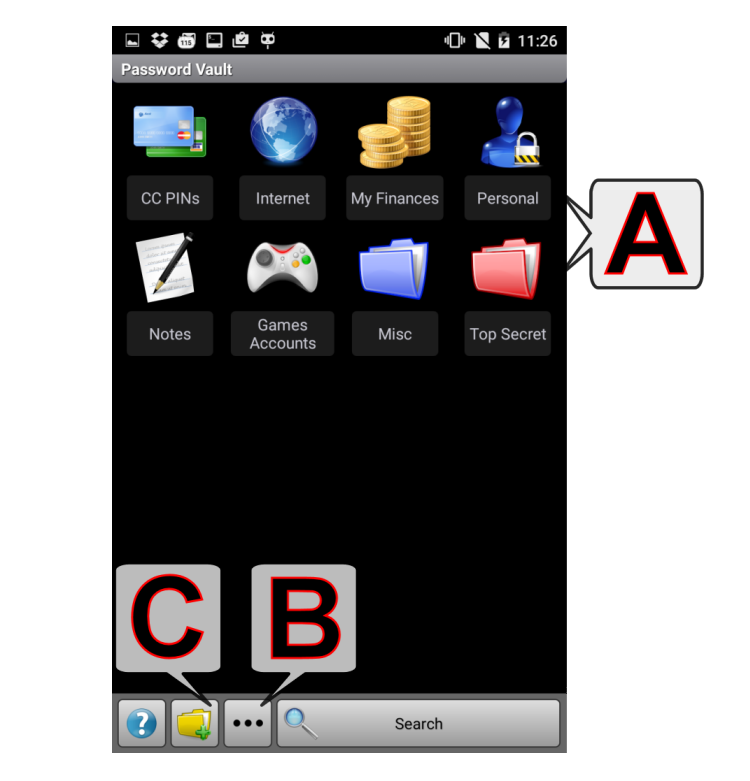
Short Click on Folder: Opens the password item list for that folder:
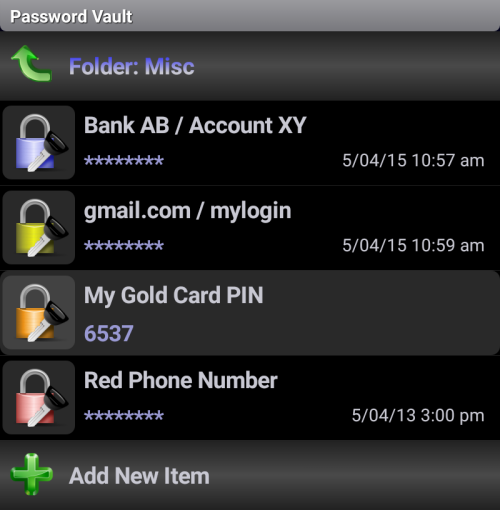
Short Click on Item: Show/Hide password
Long Click on Item: Show/Edit parameters (title, password, notes, icon, color); Delete/Move To item
Icon meanings:
- Copy to Clipboard
- Copy to Clipboard (All/Selected Paragraph—paragraphs end with the Enter key)
- Password Generator
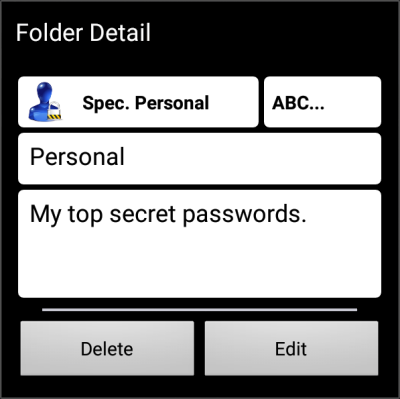
Long Click on Folder: Show/Edit/Delete folder parameters (name, notes, color, and icon):
Enforce Position (Top-Right Corner): (ABC...) This determines the folder's position. Default (ABC...) is alphabetical order; numbers refer to the absolute position. (Note: If you choose a position that is already occupied, the original folder at that position will revert to the default alphabetical order, and the edited folder will take the specified position.)
B - More Options Button
Note: Press the “Menu button” or “Expand button” (bottom-right corner) to show the Bottom Menu Bar.
Change Password: Change the “master” password for the Password Vault.
Import Vault: Import previously exported Password Vault data from the application's Import/Export Directory.
Merge Vaults: Merge current data with data from a selected file.
Export Vault: Export (backup) the current Password Vault data to the application's Import/Export Directory.
Notes:
The application's Import/Export Directory can be defined in the Application Settings.
You can choose between a compressed, fully encrypted .pwv file format and an unencrypted, editable .xml format for export.
C - New Folder
Note: Press the “Menu button” or “Expand button” (bottom-right corner) to show the Bottom Menu Bar.
Create a new password folder using the same dialog as the Show/Edit/Delete feature.
Password Autofill
Fills logins from the Password Vault into other apps and websites and, in Full mode, offers to save new logins and changed passwords to the vault. Requires Android 8.0 or newer.
Turning It On: In Settings (Password Vault section), set Password Autofill to:
Read-only: fill logins only - nothing is ever saved to the vault.
Full (fill and save): fill logins and offer to save new logins and changed passwords.
When you turn it on, you will be asked to select SSE as the autofill service of your device.
Browsers: Firefox and Opera Mini work with SSE right away. Chrome (version 135 or newer), Brave and other browsers built on Chromium use their own password manager until you change one setting: in the browser's settings, open Autofill services (in Chrome under Autofill and passwords) and choose Autofill using another service; the browser then restarts. Older versions of Chrome cannot use another autofill service. Browsers built on Chromium fill only secure (https) pages - not, for example, the http:// setup page of a router.
Filling a Login: Tap a username or password field in another app or website:
If the vault is locked, the suggestion Unlock SSE Password Vault appears. Tap it and enter your vault password.
The matching items are offered - tap one to fill the username and password.
Websites are matched by the domain in the item's URL - in browsers only: a website that another app names is ignored, so that an app cannot pose as one. Apps are matched by their app ID (package name): an item saved by autofill for the app is filled directly; an item whose URL domain or title merely resembles the app ID is filled only after you confirm it, because any app can use a familiar name.
Saving a Login (Full mode only): When you sign in with a login that is not in the vault yet, or with a changed password, Android asks whether to save it to S.S.E. (button Continue, or Save on Android 10 and older). If the vault is locked, enter your vault password. Then choose in the Save to Password Vault dialog:
New Item: The login is saved as an extended item (title, account, password, URL). By default it goes to the Autofill folder, which is created with the first save; you can choose any other folder and change the title.
Update Existing Item: Replaces the password of one of the matching items. The replaced password is kept in that item as the field Previous password (date) - only the last one is kept. A basic item is converted to an extended item, so that it can hold the account, the URL and this field.
Tap the eye icon to check the captured password before saving.
Nothing is written to the vault without your confirmation, and a login that is already in the vault is not saved again.
Password Vault Open at the Same Time: If the Password Vault is open in SSE (also in the background), the login is saved through it and it shows the change immediately. Only the item that is open for editing there cannot be updated - change it there, or save the login as a new item. If the vault changes while the save dialog is open, nothing is saved; the dialog shows the current state and you confirm again.
Security Notes:
Autofill is unlocked with the vault password. Autofill Auto-Lock in Settings sets how long it stays unlocked (default Immediately - the password is asked for every time).
Everything happens on your device - SSE has no internet access. SSE never fills its own fields.
A password that begins or ends with a space cannot be saved (the vault does not keep such spaces).
With Application Launch Protection on, a login saved by autofill while the application is locked gets into the Auto Backup file with the next change made in the vault.
More...
The entire vault is encrypted as a single object. All attributes (name, password, notes, etc.) are stored as securely as the password itself.
Forgotten Password
There is no way to access your Password Vault if you forget your password.
You can only click the Cancel button in the login (password) dialog and use the “Help me get in!” feature to reset the vault (which deletes all data).
 - Copy to Clipboard
 - Copy to Clipboard (All/Selected Paragraph—paragraphs end with the Enter key)
 - Password Generator